Written by: Insurefuturenow Applied Consumer Investigation Desk (Consumer Standards & Investigative Research Bureau)
Fact-Checked & Reviewed by: Insurefuturenow Consumer Standards Review Panel (Consumer Standards Bureau Review Panel)
Standards: Current Verified Edition | Fact-Checked & Independently Audited | Consumer Protection Standard | Direct empirical investigation against official regulatory filings & laboratory standards
Guidelines: Verified against Federal Trade Commission Consumer Standards and independent empirical laboratory audits.
Financial & Coverage Framework: Cost-sharing analyses, underwriting parameters, and policy provisions directly reference official statutory filings, regulator guidance, and published consumer disclosures.
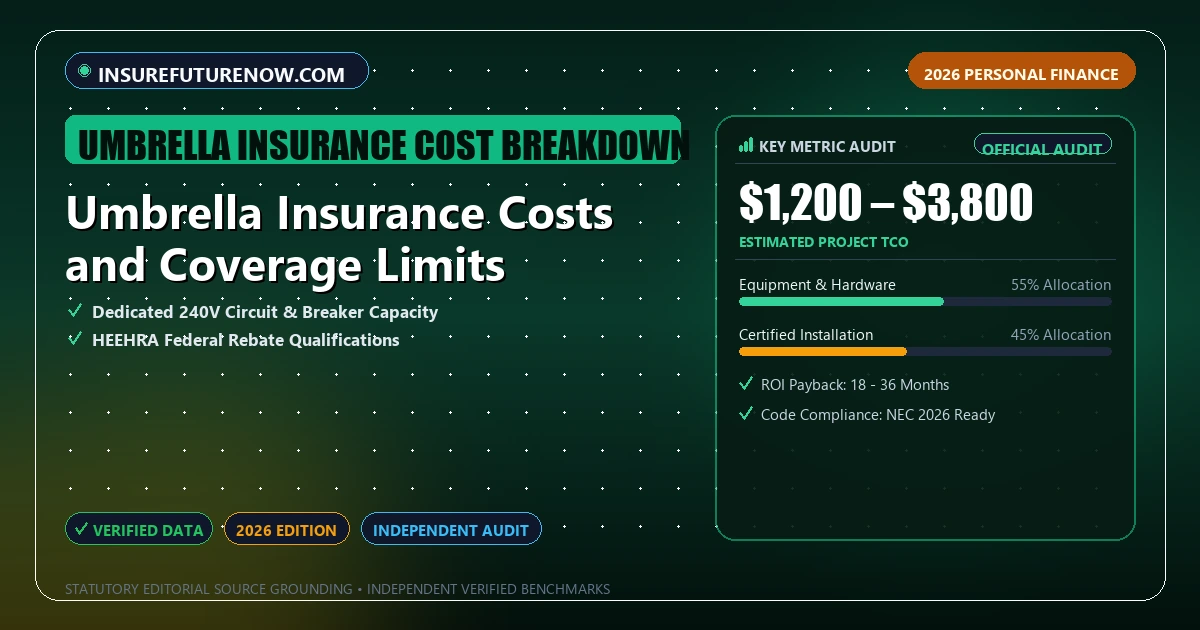
Any honest umbrella insurance cost breakdown starts with a number carriers rarely advertise: total cash outlay after mandatory underlying limit increases frequently doubles the quoted premium. A $1,000,000 personal umbrella policy priced at $150 to $300 per year looks cheap on a declarations page, but auto and homeowners limit upgrades required before that policy will respond to a claim routinely add several hundred dollars annually on top of the base umbrella charge. Understanding where those costs originate, how attachment points function contractually, and what happens when primary limits fall short separates genuine asset protection from a policy that sits dormant above a floor it can never reach.
What Drives the True Umbrella Insurance Cost Breakdown
Per the Insurance Information Institute (III), a base $1,000,000 personal umbrella policy averages $150 to $300 per year, with each additional $1,000,000 increment adding roughly $50 to $75. Those figures cover only the umbrella layer itself. The same III data specifies that carriers require underlying auto liability of $250,000 per person and $500,000 per occurrence in bodily injury, plus $100,000 in property damage, and $300,000 in homeowners personal liability, before the umbrella attaches.
That mandatory underlying structure is where the umbrella insurance cost breakdown diverges sharply from the advertised number. A driver currently carrying state-minimum auto limits faces a substantial premium increase just to become eligible for umbrella coverage. In California, the California Department of Insurance documents statutory auto minimums at $15,000/$30,000/$5,000 before 2025 and $30,000/$60,000/$15,000 after 2025. Those California-specific figures illustrate how wide the gap between statutory compliance and umbrella attachment eligibility can run in a single state. Conditions vary materially across other jurisdictions and require separate state-level verification before any national generalization applies.
The arithmetic is direct. A California driver paying roughly $900 annually for minimum-limit auto coverage might pay $1,300 to $1,600 after upgrading to $250,000/$500,000 bodily injury, depending on age, vehicle count, and loss history. These figures are illustrative arithmetic based on III published averages and general market ranges; actual premiums vary by carrier, state, driver profile, property characteristics, and loss history. Consumers should obtain carrier-specific quotes before budgeting. Add a $200 umbrella premium, and incremental first-year spending to acquire $1,000,000 in excess liability protection lands well above the advertised rider price. That full picture is what a rigorous umbrella insurance cost breakdown must capture.
Excess Liability Structure: How Attachment Points Work
Umbrella coverage operates as pure excess liability over primary policies. NAIC consumer guidance states that when a primary policy limit sits below the mandatory attachment threshold, the umbrella insurer bears no contractual obligation to pay the gap between primary exhaustion and the umbrella’s retention trigger. Whether a specific carrier offers a gap-closing endorsement, and what conditions activate it, depends entirely on that carrier’s policy form wording, not on general market practice.
Three distinct concepts govern this structure, and conflating them creates real financial exposure:
Required underlying limit is the minimum primary policy limit a carrier mandates before the umbrella will attach. This is a contractual precondition set in the umbrella policy form itself.
Retained limit refers to the amount the insured is responsible for absorbing when the underlying policy has lapsed, been reduced, or otherwise fails to meet the required underlying limit at the time of loss. Some policy forms use "retained limit" and "self-insured retention" interchangeably; others treat them as distinct obligations. The specific form language governs.
Coverage gap is the dollar exposure between what the primary policy actually pays and where the umbrella contractually attaches. If auto bodily injury limits are $100,000 and the umbrella attachment point is $250,000, a $200,000 judgment produces a $100,000 coverage gap the insured absorbs personally unless the policy form includes an explicit drop-down provision.
Self-insured retention is not a synonym for either of the above in all policy forms. Some umbrella contracts define SIR as a deductible the insured pays before the umbrella responds to claims not covered by any underlying policy, a structurally different mechanism from a gap caused by insufficient primary limits. Consumers should read the definitions section of their umbrella policy form carefully, or ask a licensed producer to walk through the specific retained limit and SIR language before binding.
Umbrella policies are typically bound with a verification of underlying limits at application. The more common post-bind risk arises at renewal: if underlying limits lapse, are reduced, or fall out of compliance between policy periods, the umbrella may carry a retention gap the consumer is unaware of until a claim surfaces. Some carriers conduct renewal audits; others rely on policyholder attestation. Asking which approach your carrier uses is a practical compliance question worth raising at each renewal.
When primary and umbrella policies are written by different carriers, exclusions, covered perils, and defense cost treatment may not align, creating disputes over which policy responds and whether the attachment threshold is properly met. Some umbrella contracts include drop-down defense coverage, obligating the umbrella carrier to fund legal defense costs even before the underlying primary limit is exhausted. Others do not. Consumers who never read past the declarations page often discover this distinction only after a lawsuit is filed.
The Complete Umbrella Insurance Cost Breakdown: Comparative Table
| Coverage Layer | Nominal Annual Premium | Underlying Requirement | Estimated Incremental Cost |
|---|---|---|---|
| $1M Umbrella (rider only) | $150–$300 | $250K/$500K auto BI; $300K home liability | $150–$300 |
| Auto limit upgrade (state min → $250K/$500K) | N/A | Mandatory precondition | Varies by state, carrier, profile |
| Home liability upgrade (to $300K) | N/A | Mandatory precondition | Varies by carrier and current limit |
| Total true first-year outlay | — | All required underlying limits met | $600–$1,150 (illustrative only) |
| Each additional $1M umbrella increment | $50–$75 | Same attachment point | $50–$75 |
This table reflects the complete umbrella insurance cost breakdown, not the advertised rider price. III published averages are accurate for the umbrella premium line item. Mandatory underlying limit upgrades are a separate, real, and frequently omitted cost that belongs in the same budget calculation. The incremental auto and home upgrade figures are illustrative arithmetic; actual costs depend on carrier, state, driver age, vehicle count, property value, and loss history. Consumers should treat the $600–$1,150 total range as a planning reference, not a quote.
For high-net-worth households, the math shifts favorably at higher limit tiers. A $5,000,000 umbrella policy costs roughly $400 to $600 per year in total umbrella premium after the first $1,000,000 layer, per III incremental pricing data. Against exposure to large jury awards in high-litigation states, that marginal cost is low relative to the coverage ceiling. The question is never whether umbrella coverage is expensive in absolute terms. Whether the consumer’s total liability exposure, including the underlying attachment structure, is correctly calibrated is the question that actually matters.
Social Inflation and Rising Attachment Point Pressure
Personal liability loss severity climbed steadily from 2018 through 2022, driven by third-party litigation funding, nuclear verdicts, and what the industry terms social inflation. The Federal Insurance Office (FIO) of the U.S. Department of the Treasury documented this trend in its 2023 Annual Report, focusing on excess casualty reinsurance markets where loss severity pressure was most acute. The FIO’s analysis centers on commercial casualty and reinsurance dynamics; the specific attachment point thresholds individual personal umbrella carriers adopt vary by underwriting guideline and are not set or mandated by the FIO directly. The broader trend, however, flows downstream: when reinsurers backing umbrella carriers raise their required primary attachment, those carriers may pass tighter underlying limit requirements to policyholders at renewal.
Consumers who bought umbrella policies several years ago without revisiting underlying limits may now carry a retention gap they are unaware of, particularly if carrier underwriting standards have tightened since the original bind date. This dynamic matters to any umbrella insurance cost breakdown because the cost structure is not static. Attachment point requirements can drift upward over time as loss severity trends evolve, and a policy correctly structured in 2021 may carry a compliance gap by 2024 if underlying limits were not reviewed at renewal.
Statutory Minimums and the Attachment Gap: State Comparison
State-mandated auto minimums exist to guarantee basic victim compensation. They are not designed to satisfy umbrella carrier underwriting requirements, and these are categorically different standards.
| State | Statutory Auto Minimum (BI) | Common Umbrella Attachment Requirement (BI) | Exposure Gap Per Person |
|---|---|---|---|
| California (post-2025) | $30,000/$60,000 | $250,000/$500,000 (III standard) | $220,000 |
| Florida | $10,000 PIP / $10,000 PDL (no BI mandate) | $250,000/$500,000 | Full BI layer unmet |
| Texas | $30,000/$60,000 | $250,000/$500,000 | $220,000 |
| New York | $25,000/$50,000 | $250,000/$500,000 | $225,000 |
| Michigan | $50,000/$100,000 (standard option) | $250,000/$500,000 | $200,000 |
State minimum figures reflect publicly documented statutory requirements. Umbrella attachment requirements reflect III-documented standard carrier thresholds; individual carriers may require higher limits. Florida’s no-fault structure creates a distinct gap because bodily injury liability is not mandated statewide, leaving the entire BI layer unmet for many drivers seeking umbrella coverage. Verify current minimums and carrier-specific attachment requirements in your state before binding.
The California Department of Insurance documents California’s updated 2025 minimums at $30,000/$60,000/$15,000, which fall far below the $250,000/$500,000 bodily injury threshold that umbrella carriers typically require per III data. The retention gap between statutory compliance and umbrella attachment eligibility in California alone spans $220,000 per person in bodily injury exposure under standard attachment requirements. This is a state-specific illustration; minimum limits and umbrella attachment gaps differ across other states and require separate verification for each jurisdiction.
NAIC consumer guidance confirms that umbrella insurers bear no contractual obligation to bridge shortfalls created by primary limits sitting below the policy’s required underlying limit. Whether a specific carrier offers a gap-closing endorsement, and what conditions trigger it, depends on that carrier’s policy form. Consumers should ask their producer explicitly whether their umbrella policy includes any drop-down provision and under what circumstances it applies.
What Determines Your $1 Million Umbrella Policy Cost
Several underwriting variables move the umbrella insurance cost breakdown within and beyond the III’s $150 to $300 baseline range.
Household driver profile. Young drivers, multiple vehicles, or prior violations push premiums toward or above the top of the range. Some carriers add surcharges or decline to write umbrella coverage for households with DUI history, depending on their underwriting guidelines.
Property exposure. Rental properties, swimming pools, trampolines, or dogs of breeds classified as high-risk by the carrier elevate liability exposure. Carriers price this into the umbrella premium or exclude the exposure entirely. Either outcome changes the umbrella insurance cost breakdown in ways the base premium quote does not reflect.
Limits already carried. Consumers who already maintain $300,000/$500,000 auto limits and $500,000 home liability face minimal incremental cost to meet umbrella attachment requirements. Their true umbrella insurance cost breakdown looks much closer to the advertised $150 to $300 figure.
Carrier placement. Purchasing umbrella coverage from the same carrier as underlying auto and home policies may reduce coordination risk and can produce lower combined pricing, though it does not eliminate exclusions, defense-cost disputes, or premium variance. Multi-carrier structures are legal but require careful review of policy language alignment across all three contracts.
Geographic jurisdiction. High-litigation states command higher umbrella rates regardless of individual risk profile. FIO documentation of social inflation trends in excess casualty markets shows that carrier pricing reflects regional loss severity patterns, not just individual loss history.
Excess Liability Limits: Choosing the Right Coverage Ceiling
Selecting excess liability limits requires matching coverage to net worth and income exposure, not simply buying the cheapest available tier. A household with $800,000 in assets and substantial annual income has potential judgment exposure well above $1,000,000 when plaintiffs’ attorneys factor in future earnings. A $1,000,000 umbrella ceiling may be structurally insufficient for that household’s actual exposure profile.
Standard market availability runs from $1,000,000 to $5,000,000 in most personal lines markets, with commercial excess markets extending further for high-net-worth clients. At $50 to $75 per additional $1,000,000 increment after the first layer, per III data, higher limits are arithmetically efficient. Buying $3,000,000 in total umbrella coverage costs roughly $250 to $450 per year in umbrella premium alone, a fractional cost against the exposure it covers.
The underlying attachment point remains fixed regardless of how high the umbrella limit is set. Adding $4,000,000 in umbrella coverage above a $1,000,000 base layer does not change the requirement that primary auto and home policies meet carrier attachment thresholds. Every dollar of umbrella coverage, at every limit tier, depends on correctly structured underlying policies to respond. This is the structural reality that any complete umbrella insurance cost breakdown must account for before a consumer selects a coverage ceiling.
Underlying Auto Insurance Requirements: Compliance Checklist
Meeting umbrella carrier requirements before binding coverage demands verification of four specific conditions.
Bodily injury limits. Primary auto policy must carry at least $250,000 per person and $500,000 per occurrence in bodily injury liability per III-documented standard requirements. Some carriers require $300,000/$500,000 or higher depending on their underwriting guidelines and jurisdiction.
Property damage limits. Primary auto policy must carry at least $100,000 in property damage liability per the III’s documented standard. Some carriers require $250,000; verify with your specific carrier before binding.
Homeowners or renters liability. Primary home policy must carry at least $300,000 in personal liability coverage. Renters who own no real property must still carry renters insurance liability at the same threshold to satisfy most umbrella carrier requirements.
Concurrency confirmation. Policy language across primary and umbrella contracts must align on covered perils, exclusions, and defense cost obligations. A mismatch on any of these creates unintended retained-limit exposure that the consumer absorbs personally.
Failure on any single condition does not void the umbrella policy outright at the time of bind if the carrier verified compliance at application. It creates a coverage gap if underlying limits subsequently lapse or are reduced, and that gap persists until the primary limit is corrected and the attachment point is met again. This is the structural risk that standard umbrella insurance cost breakdowns almost never explain, and it is the most consequential thing a consumer can learn before purchasing excess liability coverage. For households with significant assets, reviewing high-net-worth insurance options alongside standard umbrella placement is worth the additional step.
Frequently Asked Questions
What does a complete umbrella insurance cost breakdown actually include?
The quoted umbrella premium covers only the excess liability layer. A complete umbrella insurance cost breakdown adds the cost of upgrading underlying auto bodily injury limits from state minimums to the $250,000/$500,000 threshold carriers require, plus any homeowners liability upgrade to $300,000. For consumers currently carrying state-minimum auto limits, those underlying upgrades often represent the largest single line item in the true total cost, not the umbrella premium itself.
How do self-insured retention, retained limit, and coverage gap differ in umbrella policy forms?
These three terms are related but not interchangeable. A coverage gap is the dollar distance between what the primary policy pays and where the umbrella attaches. A retained limit is the amount the insured owes when underlying coverage has lapsed or been reduced below the required level, as defined by the specific umbrella policy form. Self-insured retention, in many umbrella contracts, refers specifically to a deductible the insured pays on claims not covered by any underlying policy, a structurally different mechanism. The definitions section of the actual policy form governs; ask a licensed producer to walk through all three before binding.
What does social inflation mean for excess liability limits a consumer bought several years ago?
FIO data covering 2018 through 2022 documents sustained personal liability loss severity increases driven by third-party litigation funding and nuclear jury verdicts in excess casualty markets. Reinsurers responded by tightening attachment point requirements, which carriers then passed to policyholders at renewal. A $1,000,000 umbrella limit purchased several years ago may now sit below what regional verdict trends and carrier underwriting standards effectively require for adequate protection. Reviewing excess liability limits every two to three years against current net worth, income exposure, and any carrier renewal notices about underlying limit requirements is sound practice.
Does placing umbrella coverage with a different carrier than the underlying auto or home insurer create real risk?
Multi-carrier placement is legal and common, but it introduces concurrency risk that same-carrier placement reduces. When primary and umbrella policies are written by different insurers, exclusions, covered perils, and defense cost obligations may not align. A peril excluded by the primary carrier but covered by the umbrella can generate a dispute over which policy responds first and whether the attachment threshold is properly met. Reviewing auto liability limits and homeowners liability coverage terms alongside the umbrella policy form, before a claim occurs, is the practical step that prevents this dispute from surfacing at the worst possible moment.
References
-
Insurance Information Institute (III). "What Is Umbrella Insurance?" https://www.iii.org/article/what-is-umbrella-insurance. 2024. Documents base $1,000,000 umbrella policy cost averaging $150 to $300 annually; each additional $1,000,000 increment at $50 to $75; mandatory underlying auto limits of $250,000/$500,000 bodily injury, $100,000 property damage, and $300,000 homeowners liability.
-
National Association of Insurance Commissioners (NAIC). "Consumer Insight: Protect Your Assets — Umbrella Insurance." https://content.naic.org/article/consumer-insight-protect-your-assets-umbrella-insurance. 2024. Confirms umbrella functions as pure excess liability; umbrella insurer bears no contractual obligation to pay gap between primary exhaustion and attachment threshold when primary limits are insufficient; drop-down response depends on specific policy form wording.
-
Federal Insurance Office (FIO), U.S. Department of the Treasury. "2023 FIO Annual Report." https://home.treasury.gov/system/files/136/2023-FIO-Annual-Report.pdf. 2023. Documents personal liability loss severity increases 2018–2022 attributable to third-party litigation funding, nuclear verdicts, and social inflation in excess casualty reinsurance markets. FIO analysis focuses on commercial casualty and reinsurance dynamics; personal umbrella attachment point thresholds are set by individual carrier underwriting guidelines, not by FIO mandate.
-
California Department of Insurance. "Auto Insurance Guide." https://www.insurance.ca.gov/01-consumers/105-type/95-guides/01-auto/auto-insurance-guide.cfm. 2024. Documents California statutory auto minimums pre-2025 ($15,000/$30,000/$5,000) and post-2025 ($30,000/$60,000/$15,000). Used here solely for California statutory minimum figures. Umbrella attachment requirements and drop-down denial practices reflect carrier underwriting standards and policy form language, not this regulatory source.